

Benefits of Graphite Golf Shafts: A 2026 Guide
Table of Contents
- What Graphite Golf Shafts Actually Change in Your Bag
- Graphite vs Steel Golf Shafts: Weight, Launch and Feel
- Do Graphite Shafts Increase Distance?
- Vibration, Shock Absorption and Reduced Joint Strain
- The Disadvantages of Graphite Iron Shafts Worth Knowing
- Graphite Golf Shaft Flex and Weight: How to Choose
- Conclusion: Matching the Shaft to Your Swing
- Frequently Asked Questions
Last Updated: October 14, 2026
What Graphite Golf Shafts Actually Change in Your Bag
The benefits of graphite golf shafts come down to four measurable changes: reduced weight, higher launch, lower shock transmission, and less fatigue over 18 holes. Everything else you read about them is a variation on those four themes.
At Prime Golf Shafts, we build graphite shafts in three flex profiles, and the questions we field most often are about whether the switch is worth it. Here is the honest version.
Graphite is a composite material: carbon fibres bound in a resin matrix, layered and oriented to control how the shaft bends under load. Steel is a uniform metal tube. That structural difference is why a graphite shaft can be made lighter without becoming unplayably soft, and why it dampens vibration rather than passing it straight into your hands.
The four changes that matter most:
- Weight: graphite builds run lighter than steel at equivalent stiffness
- Launch: a lighter, lower-kick profile tends to send the ball higher
- Shock absorption: composite construction absorbs impact vibration
- Fatigue: less mass swung repeatedly means less cumulative strain
Below, we break down each of those, then cover where graphite loses, how to pick flex and weight, and how to match a shaft to your swing rather than to a marketing claim.
Graphite vs Steel Golf Shafts: Weight, Launch and Feel
The core trade in the graphite vs steel golf shafts debate is mass against consistency.
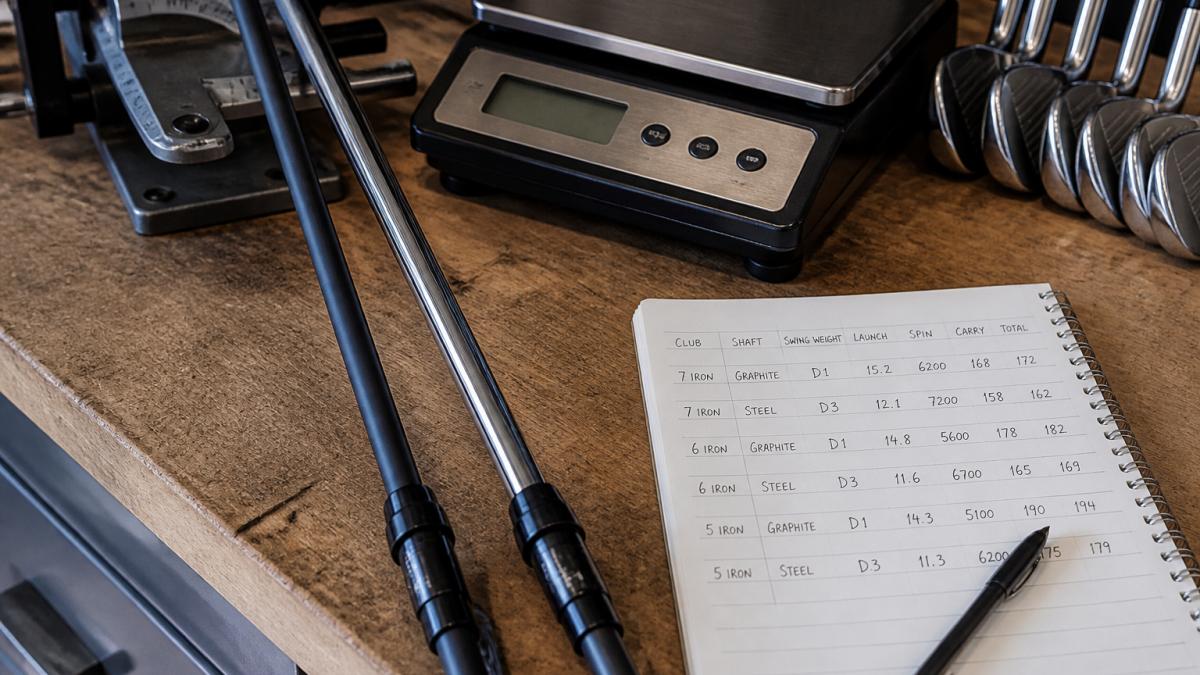
Weight. A lighter shaft is easier to swing, and for many players that translates into a touch more clubhead speed without extra effort. The catch is that lighter does not automatically mean faster for everyone.
Launch and trajectory. A lighter graphite iron shaft with a mid or mid-high launch characteristic helps get the ball airborne, which is exactly what a player who struggles to elevate long irons wants.
Feel. Graphite gives a softer, more muted sensation at impact. Steel gives a crisper, more immediate one. Neither is better; they suit different players.
Cost. A steel shaft is cheaper to produce and almost indestructible in normal play. A quality graphite build costs more, though the gap narrows sharply once you leave the premium end of the market.
Durability. Steel resists damage from bag chatter, airline travel, and the occasional slammed club. Graphite is strong along the fibres but more vulnerable to impact damage and to over-tightening in a vice during regripping.
Dispersion variability. This is the trade-off buyers underestimate. A well-built graphite shaft can be as consistent as steel. A poorly built one, with inconsistent wall thickness or fibre layup, can perform differently club to club.
Where Steel Still Wins
Steel still wins on three fronts: price, durability, and the low, heavy, repeatable flight that strong players with high swing speeds prefer.
A steel shaft is cheaper to produce and almost indestructible in normal play. It also resists the tendency to balloon the ball, which matters for a player who already hits a high, spinning flight and wants it flattened.
If you swing fast, load the shaft aggressively, and want a lower window with tight dispersion, steel remains a legitimate choice. Graphite has closed the gap, but it has not erased the advantage steel holds for that specific profile.
Do Graphite Shafts Increase Distance?
Graphite shafts can increase distance, but not because graphite is magically longer. They increase distance when the lighter weight lets you swing faster, or when the higher launch and optimised spin produce a better carry than your current setup.
Two mechanisms do the work. First, a lighter shaft can raise clubhead speed for players who are not already maxed out. Second, a higher launch angle with the right spin rate can add carry distance even at the same speed, because the ball stays in the air longer.
Where it goes wrong: if the shaft is too light or too soft for your swing, you lose the centre of the face, and off-centre contact costs you far more distance than the weight ever gave you. The gain is real but conditional. It depends on matching the shaft to your speed, tempo, and release, not on the material alone.
If you are chasing yards, get measured. A fitting session will show you your current launch conditions and what changes when you switch. Guessing costs more than the fitting.
Vibration, Shock Absorption and Reduced Joint Strain
Shock absorption is the most underrated benefit of graphite golf shafts, and for many players it is the reason they switch. Composite material dampens the vibration that travels up the shaft at impact, so less of it reaches your hands, wrists, and elbows.
That matters if you play regularly, practise on mats, or already feel stiffness after a round. Mats are unforgiving; the impact vibration from a mat is sharper than from turf, and it accumulates over a bucket of balls.
Players with hand or wrist sensitivity often report that the switch makes the game more comfortable, which keeps them practising. Comfort is not a soft benefit. A player who can hit 100 balls without discomfort improves faster than one who stops at 40.
This is not a medical claim. If you have persistent joint pain, see a professional. But if the issue is impact vibration from repetitive practice, a shock-absorbing shaft addresses the cause directly.
Prime Graphite Shaft | X Flex →
The Disadvantages of Graphite Iron Shafts Worth Knowing
The disadvantages of graphite iron shafts are cost, inconsistency at low price points, and a tendency to launch too high or spin too much for fast, high-ball hitters.
Cost is the obvious one. A quality graphite build costs more than a stock steel shaft. Cheaper graphite is where the material's reputation suffers: inconsistent wall thickness and poor fibre layup produce a shaft that feels vague and performs differently club to club.
The second drawback is trajectory. If you already hit a high, spinning flight, a light graphite shaft can balloon your ball and cost you distance into wind. The fix is a heavier graphite profile with a lower launch characteristic, not a return to steel.
The third is feedback. Some players find graphite too muted and lose the sense of where they struck it. That is a preference, not a flaw, but it is worth knowing before you commit.
Graphite Golf Shaft Flex and Weight: How to Choose
Choosing graphite golf shaft flex and weight comes down to three numbers: your clubhead speed, your tempo, and your release point. Flex is not a status symbol, and weight is not a proxy for manliness. Most guides stop at a flex chart.
Here is a practical order of operations.
Step 1, Establish your baseline. Before changing anything, note your current shaft's weight in grams, its flex designation, and your typical carry and dispersion with a mid iron and a driver. Without a baseline you cannot tell whether a change helped.
Step 2, Set weight first, flex second. Weight has a larger effect on how a shaft feels and performs than the letter on the label. A useful rule of thumb is to move in small increments rather than jumping to the lightest option available:
- If you currently play a steel iron shaft in the 110-130 g range, a graphite shaft in the 75-95 g range is a realistic first step.
Step 3, Match flex to transition, not just speed. Flex describes how much the shaft bends under load. Regular suits smoother tempos and moderate speeds. Stiff suits faster, more aggressive transitions. Extra stiff suits high speed with a hard load.
Step 4, Treat torque as a fine-tuning dial. Torque measures how much the shaft twists on off-centre hits. Lower torque feels tighter and more stable; higher torque feels smoother but can wander.
| Profile | Best For | Typical Flight | What It Fixes |
|---|---|---|---|
| R Flex | Smooth tempo, moderate speed | Mid to mid-high | Low launch, heavy feel |
| S Flex | Faster tempo, stronger load | Mid | Inconsistent dispersion |
| X Flex | High speed, hard transition | Mid-low | Ballooning, loose feel |
Step 5, Match the shaft to the club, not just the golfer. Graphite suits different clubs for different reasons.

Prime Golf Shafts builds all three profiles with Active Taper Technology, which keeps the feel smooth through the load while holding stability at impact. Each shaft is custom built and you can specify grip, adapter, and playing length.
Conclusion: Matching the Shaft to Your Swing
The benefits of graphite golf shafts are real but conditional: lighter weight for speed, higher launch for carry, and shock absorption for comfort. None of it works if the flex and weight do not match how you actually swing.
The mistake is treating graphite as a single upgrade rather than a category with many profiles. A well-matched graphite shaft transforms the club. A poorly matched one confirms every bad thing you have heard about the material.
That is why we build to your numbers rather than to a shelf. Three profiles, custom length, grip and adapter, and a build designed to hold stability while staying smooth through the load.
Get started with Prime Golf Shafts and find the profile that matches your swing.
Frequently Asked Questions
Is it worth getting graphite shafts?
It depends on what you want from your irons. Graphite golf shafts are lighter and absorb vibration better than steel, which can help if you want more launch, less hand and wrist strain, or a smoother feel through impact. If you already hit a high, tight ball flight with steel and like the feedback, the gain may be small. A fitting session that measures swing speed, launch angle and dispersion will tell you whether the change is worth the spend.
What are the disadvantages of graphite iron shafts?
The main ones are cost, feel and dispersion. Graphite iron shafts cost more than basic steel, and some players find the lighter weight harder to time, which can widen dispersion until they adjust. A softer tip can also send spin and launch higher than a stronger player wants. Torque and stiffness vary a lot between models, so a cheap graphite shaft can feel loose where a well-specified one feels stable.
Do you hit farther with graphite shafts?
Do graphite shafts increase distance? Sometimes, but not automatically. A lighter shaft can raise swing speed, and a higher launch angle can add carry distance, which is where most of the gain shows up. Carry distance only improves if the new launch and spin conditions suit your swing. A shaft that is too light or too soft can add spin and lose you distance instead, so the fitting matters more than the material label.
Are graphite shafts easier on your joints?
Graphite absorbs vibration and shock transmission better than steel, so less impact energy reaches your hands, wrists and elbows. Players who feel hand strain or joint pain after a round often notice the difference most in irons and wedges, where the club meets the ground. It is a comfort and fatigue benefit rather than a treatment, and it does not replace a proper fitting or medical advice if pain persists.
Can better players use graphite iron shafts?
Yes. Stronger players and low handicappers use graphite in irons and wedges when the profile matches their swing. The key is stiffness, weight and torque rather than the material itself. A heavier, stiffer graphite shaft with a stable tip can deliver the penetrating ball flight and shot-to-shot consistency a stronger player wants, while still cutting vibration. Try before you commit and compare dispersion numbers, not just feel.
How do I choose the right graphite shaft flex and weight?
Start with swing speed and tempo, then confirm with launch data. Faster, more aggressive swings usually suit a stiffer flex and a heavier shaft, while smoother tempos often work well with a lighter, more responsive profile. Flex and weight change launch angle, spin rate and dispersion, so the right combination is the one that tightens your shot pattern. A custom fitting that measures ball speed, launch and dispersion is the fastest route to the correct specification.