

How to Choose Golf Shafts: A 2026 Guide
Table of Contents
- What You'll Need Before Choosing a Shaft
- Understanding Shaft Flex and How to Choose the Right One
- Golf Shaft Weight Guide: Impact on Distance and Control
- Driver Shaft Fitting: Optimising Launch and Stability
- Iron Shaft Fitting: Consistency and Dispersion
- Key Shaft Specifications: Material, Length, Torque, and Kick Point
- Common Shaft Selection Mistakes to Avoid
- Testing Your Shafts: Range Protocol and Launch Monitor Data
- Frequently Asked Questions
Last Updated: October 10, 2026
What You'll Need Before Choosing a Shaft
To choose golf shafts effectively, collect your swing data, know your current setup, and identify what you want to improve. Most golfers skip this step and end up with shafts that don't match their swing.
You'll need a launch monitor to capture clubhead speed, ball speed, launch angle, spin rate, and carry distance. Without this data, you're guessing.
Check your current shaft's flex, weight, length, and torque to establish a baseline for comparison.
Understanding Shaft Flex and How to Choose the Right One
Shaft flex determines how much the shaft bends during your swing, directly affecting launch angle, spin rate, and control.
Flex categories run from L (ladies) through A (amateur), R (regular), S (stiff), and X (extra stiff). The faster your swing, the stiffer the flex you need. Too flexible feels unstable; too stiff feels dead and costs distance.

Reading a Golf Shaft Flex Chart
A golf shaft flex chart maps swing speed to recommended flex. Find your clubhead speed and trace to your flex category as a starting point. The chart shows guidelines, not absolutes; your tempo and transition narrow the choice.
Flex Matching to Swing Speed
Swing speed is the primary driver of flex selection. Here's how it typically breaks down:
- L Flex: Under 60 mph clubhead speed
- A Flex: 60-75 mph
- R Flex: 75-90 mph
- S Flex: 90-105 mph
- X Flex: 105+ mph
A smooth swing at 95 mph might play better in R flex; an aggressive swing at the same speed might need S flex. Launch monitor data reveals which flex performs best with your swing.
Swing Tempo and Transition: The Hidden Flex Variable
Two golfers with identical 95 mph clubhead speeds can require different flexes based on tempo and transition. A smooth, rhythmic tempo loads the shaft gradually and suits softer flex (R or A). A quick, aggressive tempo loads the shaft rapidly and requires stiffer flex (S or X).
A fast, explosive transition requires stiff flex for stability. A smooth, gradual transition suits softer flex. Record slow-motion video to estimate your transition speed: under 0.4 seconds suggests stiff flex; 0.6+ seconds suggests softer flex.
Common Flex Selection Mistakes
Common mistakes: choosing flex by ego rather than swing speed (costs distance and consistency); assuming stiffer flex fixes a slice (it won't without the right kick point); ignoring tempo (two golfers at 90 mph may need different flexes). Launch monitor data reveals the right choice.
Golf Shaft Weight Guide: Impact on Distance and Control
Lighter shafts promote higher swing speeds and launch angles; heavier shafts improve control. Most graphite shafts weigh 50-80 grams. Weight distribution matters: tip-heavy promotes lower launch and control; tip-light promotes higher launch and distance. A 60-70 gram shaft offers good balance for most golfers.
Driver Shaft Fitting: Optimising Launch and Stability
Driver shafts must match your swing speed and launch preferences. Too stiff produces low launch and thin flight; too flexible produces high launch and excess spin. Most golfers benefit from 12-16 degrees of launch angle. The right flex feels stable and predictable through impact.
Iron Shaft Fitting: Consistency and Dispersion
Iron shafts prioritise consistency and dispersion. A well-fit iron shaft keeps shots tight and predictable. Iron shafts are slightly heavier and stiffer than driver shafts for the same flex rating, promoting penetrating flight and tight groupings. All irons should use the same flex for consistency.
Key Shaft Specifications: Material, Length, Torque, and Kick Point
Beyond flex and weight, four additional specifications define how a shaft performs: material, length, torque, and kick point.
Steel vs Graphite Shafts
Steel shafts are heavier, durable, and less expensive; they're standard in iron sets for reliable performance. Graphite shafts are lighter, more forgiving, and more expensive; they're common in drivers and fairway woods and suit slower swing speeds in irons.
Shaft Length and Its Effect on Contact
Shaft length affects distance and accuracy. Longer shafts increase swing speed but reduce contact consistency; shorter shafts improve control but reduce distance. Standard lengths are approximately 45.5 inches for drivers and 38-39 inches for 6-irons. Custom lengths can be optimised for your height and swing.
Torque Rating and Stability
Torque measures how much a shaft twists during the swing. Lower torque (2-3 degrees) means less twisting and more stability. Higher torque (4-5 degrees) means more twisting and more feel.
Lower-torque shafts suit golfers with aggressive transitions and high swing speeds. Higher-torque shafts suit golfers with smoother tempos and moderate swing speeds. Torque interacts with flex: a softer flex with low torque can feel unstable, while a stiff flex with high torque can feel sluggish.
Kick Point and Ball Flight
The kick point (also called bend profile) determines where the shaft flexes most during the swing. A low kick point flexes more near the tip, promoting higher launch. A high kick point flexes more near the grip, promoting lower launch.
Low kick point shafts suit golfers seeking higher launch and more distance. High kick point shafts suit golfers seeking lower launch and more control. Mid kick point shafts offer a balanced profile for most players.
Common Shaft Selection Mistakes to Avoid
Most golfers make predictable errors when choosing shafts. Awareness helps you avoid them.
The first mistake when you choose golf shafts is selecting flex based on what others play rather than your actual swing speed. Your mate plays X flex, so you assume you should too. Your mate's swing speed might be 15 mph faster than yours. Get your own data.
The second mistake is prioritising feel over performance data. A shaft might feel good at address but perform poorly on the launch monitor. Trust the numbers. Feel matters, but it's secondary to performance.
Prime Graphite Shaft | X Flex →
The third mistake is changing too many variables at once. New shaft, new flex, new weight, new length, new adapter. If something doesn't work, you won't know which variable caused the problem. Change one thing at a time.
The fourth mistake is ignoring shaft length. Most golfers play stock lengths that don't match their height or swing characteristics. A custom length often improves contact consistency more than any other single change.
Testing Your Shafts: Range Protocol and Launch Monitor Data
Testing shafts properly requires a repeatable protocol and the ability to read launch-monitor data in context. Many golfers collect numbers without understanding what they mean or how to act on them.
Setting Up a Repeatable Test
Hit at least 10 shots with each shaft configuration. Consistency matters more than peak performance. A shaft that produces tight groupings across multiple shots indicates a good match; wide dispersion suggests a mismatch between the shaft and your swing.
Test with your normal swing tempo first. Then hit 5-10 shots with a slightly faster, more aggressive tempo. Real golf demands both. A shaft that works beautifully with a smooth rhythm might feel unstable when you accelerate through impact. Conversely, a shaft that suits an aggressive transition might feel sluggish with a controlled swing. If you play both ways, and most golfers do, the shaft needs to handle both.
Use the same club head, adapter, and lie angle for all tests. Change only the shaft. If you swap multiple variables at once, you won't know which one caused any improvement or problem.
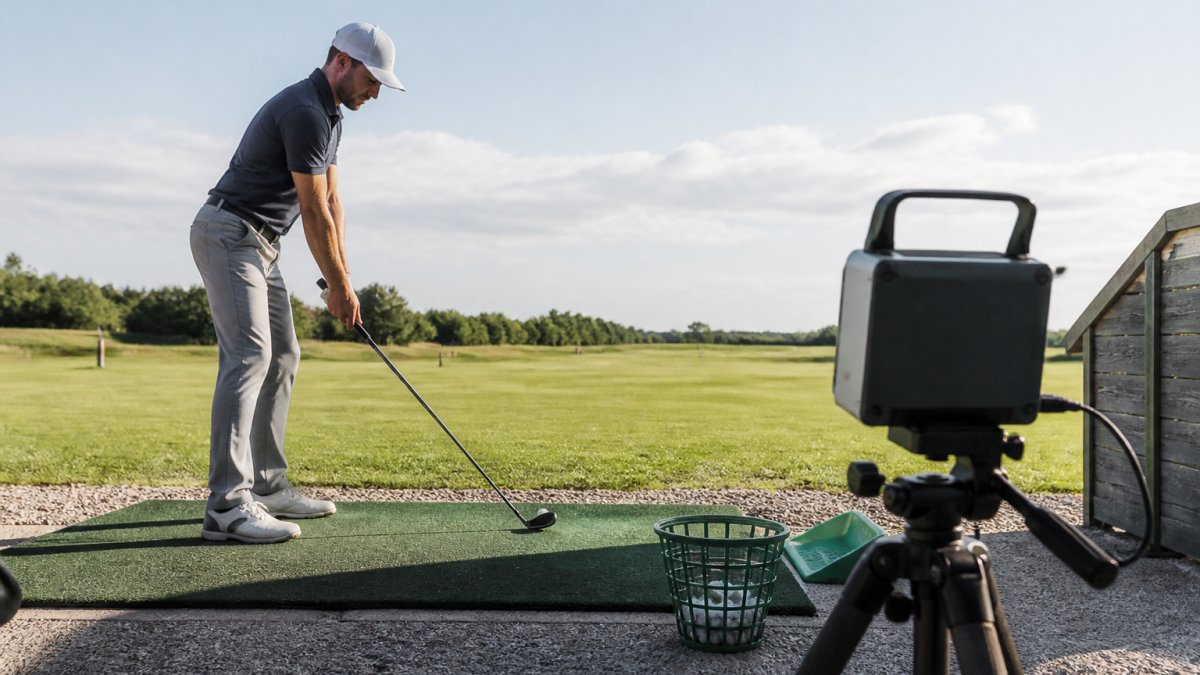
Interpreting Launch Monitor Data
Launch monitors measure six key outputs. Understanding what each one means, and how they interact, transforms raw numbers into a decision.
Clubhead Speed is your baseline. It should remain consistent across shaft tests (within 1-2 mph).
Ball Speed should be approximately 1.45 times your clubhead speed (this ratio is called smash factor). If ball speed is lower than expected, the shaft may not be loading and unloading efficiently with your swing.
Launch Angle is the trajectory off the club face. For drivers, most golfers benefit from 12-16 degrees. Below 12 degrees, the ball flies too low and may not carry as far despite high ball speed.
Spin Rate is revolutions per minute. For drivers, 2000-3000 rpm is the sweet spot for most golfers. Below 2000 rpm, the ball may balloon or dive unpredictably.
Carry Distance is how far the ball flies. Track this across all 10 shots. A shaft that produces consistent 280-yard carries is more valuable than one that produces one 295-yard drive and several 260-yard drives.
Dispersion is the scatter pattern of your shots. Measure the distance between your longest and shortest carry, and the left-right spread.
Using Data to Make a Decision
After testing two or three shaft options, compare them side by side:
-
Eliminate by consistency first. Which shaft produced the tightest dispersion across 10 shots? That's your strongest candidate, regardless of peak distance.
-
Check the launch angle and spin rate against your ball speed. If launch angle and spin rate are both in the optimal range for your ball speed, the shaft is loading correctly. If one is off, the shaft may not suit your swing.
-
Verify clubhead speed didn't drop. If a new shaft causes you to swing slower, it's fighting your natural tempo. Reject it.
-
Compare carry distance across the tight-dispersion shafts. The shaft with the highest average carry (not peak carry) is the winner, assuming launch angle and spin rate are both acceptable.
-
Feel matters second. Once you've narrowed the choice by data, pick the shaft that feels best at address and through impact. Feel won't override poor data, but it breaks ties.
Hit shots with different swing tempos too. A shaft that works with a smooth tempo might feel unstable with an aggressive tempo. Real golf demands both. Test both.
Frequently Asked Questions
How do I know what golf shaft flex I need?
Shaft flex selection depends primarily on your swing speed and tempo. Regular flex suits swing speeds of 80-95 mph, stiff flex works for 95-110 mph, and extra stiff handles 110+ mph. If you're unsure, use a launch monitor at a fitter or range to measure your clubhead speed, then cross-reference against a golf shaft flex chart. Your swing tempo and transition also matter; smoother, slower transitions may benefit from a slightly more flexible shaft than your speed alone suggests.
Does golf shaft weight affect distance and accuracy?
Yes. Lighter shafts (around 50-60 grams) promote higher swing speeds and launch, beneficial for slower swingers seeking distance. Heavier shafts (70+ grams) improve control, stability, and shot consistency, especially for faster swingers. Weight also influences feel and feedback; lighter shafts feel more responsive, heavier ones feel more stable. Choose based on your speed and whether you prioritise distance or control.
Should driver and iron shafts have the same flex?
Not necessarily. Many golfers use the same flex across their set for consistency, but some prefer a slightly softer driver shaft to maximise launch and distance, paired with stiffer irons for control. Your swing characteristics dictate the best choice. A fitter can recommend whether matching flexes or staggering them suits your swing better. Tour players often use different flexes strategically based on club type and desired ball flight.
Is a professional golf shaft fitting worth it?
Yes, if you're serious about performance. A professional fitting uses launch monitor data to measure your swing speed, launch angle, spin rate, and ball flight, removing guesswork. Fitters analyse your tempo, transition, and load characteristics to recommend flex, weight, torque, and kick point tailored to your swing. Many golfers gain 10-15 yards and improved consistency after a proper fitting. Even if you can't afford a full fitting, understanding your swing speed and tempo helps you choose shafts confidently.