

How to Measure Golf Shaft: Step-by-Step Guide
Table of Contents
- Why Measuring Your Golf Shaft Matters
- Understanding Raw Golf Shaft Length vs Playing Length
- What You'll Need to Measure Your Golf Shaft
- Step-by-Step: How to Measure Golf Shaft Length
- How to Measure Golf Club Length for Different Clubs
- Golf Shaft Length Chart: Standards by Club Type
- Recommended Driver Shaft Length Based on Your Swing
- Common Measurement Mistakes to Avoid
- Frequently Asked Questions
Last Updated: October 12, 2026
Why Measuring Your Golf Shaft Matters
Getting the right shaft length is the foundation of consistent ball striking and swing control. A shaft that's too long forces you to compensate; one that's too short limits your reach and distance. The difference between a fitted shaft and a stock one can shift your entire game.
The shaft is the engine of your club, and getting the length right is where everything starts.
Before you buy a custom shaft or upgrade your setup, you need to know what you're working with. This guide walks you through measuring your golf shaft correctly so you can make informed fitting decisions.
Understanding Raw Golf Shaft Length vs Playing Length
This distinction is the biggest source of confusion when golfers buy shafts online. Raw shaft length is measured from the tip of the shaft to the butt end, before any grip is installed and before the shaft is inserted into a clubhead. Playing length is the finished measurement of the assembled club, from the clubhead sole to the butt end of the grip. Mixing them up is how golfers end up with a club that plays an inch shorter or longer than intended.
What actually changes the number
Four things sit between a raw shaft measurement and the finished playing length:
- Hosel bore depth. The shaft is inserted into the clubhead hosel by a set amount, typically around 2.5 to 3 cm on a driver and slightly more on some irons. That inserted portion no longer counts toward the visible length.
- Grip cap. A standard grip adds roughly 0.6 cm beyond the butt end of the shaft. A thicker or longer grip can add more.
- Butt trimming. If the shaft is trimmed at the butt end to shorten the finished club, the raw length drops by the same amount before assembly.
- Tip trimming. Tip trimming affects flex and ball flight rather than finished length, but it changes where the shaft seats in the hosel on some head designs.
A common pattern is a raw driver shaft measuring around 117 cm tip to butt. After hosel insertion, butt trim and grip installation, the finished playing length often lands closer to 114 cm or a little under, depending on the head and the target length.
Converting between the two
To estimate playing length from raw length, subtract the hosel bore depth, add the grip cap, then subtract any planned butt trim. To order a raw shaft from a playing length, work backwards: add the hosel bore depth, subtract the grip cap, and add back any butt trim.
Sellers quote raw shaft length while fitters quote playing length. When shopping for a replacement shaft, check which number the listing uses; when fitting a club, playing length is the only figure that matters on the course.
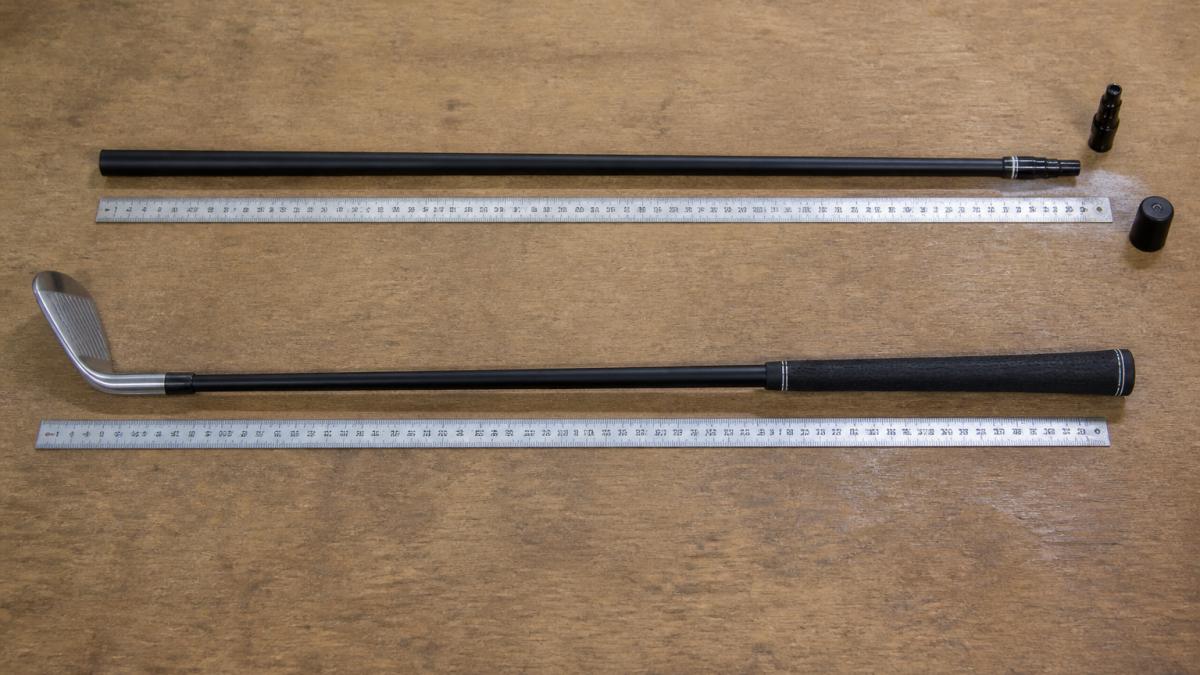
What You'll Need to Measure Your Golf Shaft
You don't need expensive tools:
- A measuring tape (cloth or steel, at least 120 cm long)
- A ruler or straightedge (30 cm minimum, preferably 60 cm)
- A flat, hard surface (workbench, table, or flooring)
- Your golf club or shaft
- A pen and paper to record measurements
A flat surface is essential for a raw shaft, and for a finished club you'll want a way to mark where the clubhead sole sits. The straightedge is optional but helps align the tape perpendicular to the shaft, reducing error.
Step-by-Step: How to Measure Golf Shaft Length
Step 1: Prepare Your Measurement Surface
Find a flat, level work area, a kitchen table, workbench, or concrete floor. Avoid carpet, which creates uneven contact points.
Lay a finished club flat with the clubhead sole flush against the surface, or place a raw shaft straight along it with no bend. The shaft should lie completely flat; any angle or gap introduces error.
Step 2: Position the Clubhead Correctly
For a finished club, position the clubhead so the sole sits flat, with the heel (the part closest to the shaft) as your reference point. Mark where the heel meets the surface, that's your starting point.
For a raw shaft, start at the very tip. Make sure it's clean and undamaged; any burr or bend will throw off your measurement.
Step 3: Align Your Measuring Tool
Lay your measuring tape along the shaft in a straight line, starting at the heel (finished club) or the tip (raw shaft). Keep the tape flat and untwisted.
Extend it toward the grip end, stopping where the grip ends (finished club) or at the butt end (raw shaft). Use your straightedge to keep the tape aligned, any angle or gap creates error, so take your time here.
Step 4: Record Your Measurement
Read the measurement where the tape ends and write it down immediately, including the club type (driver, 5-wood, 6-iron, etc.) and shaft flex (R, S, X) if you know it.
Record each club separately and note whether you measured raw shaft length or playing length. Measure twice, if the numbers differ, remeasure and average them.
How to Measure Golf Club Length for Different Clubs
Club length varies across your bag, drivers are longest, wedges shortest. Knowing the differences helps you spot a non-standard club.
Driver: Measure from the clubhead heel to the grip end. Standard playing length ranges from 109 to 117 cm depending on your height and swing speed.
Fairway woods and hybrids: These typically run 2.5 to 5 cm shorter than drivers. A 3-wood might measure 109 cm. A hybrid might be 101 to 104 cm.
Long irons (2-4 irons): These start around 99 to 101 cm.
Mid irons (5-7 irons): These sit around 96 to 99 cm.
Short irons (8-9 irons, PW): These measure 91 to 96 cm.
Wedges (GW, SW, LW): These are shortest, typically 89 to 91 cm.
These are approximate ranges. Your clubs may differ, especially after custom work or a used purchase, which is why measuring matters.
Golf Shaft Length Chart: Standards by Club Type
| Club Type | Standard Playing Length | Typical Range |
|---|---|---|
| Driver | 113 cm | 109-117 cm |
| 3-Wood | 108 cm | 104-109 cm |
| 5-Wood | 105 cm | 101-106 cm |
| Hybrid | 101 cm | 99-104 cm |
| 2-Iron | 99 cm | 96-101 cm |
| 3-Iron | 99 cm | 96-101 cm |
| 4-Iron | 97 cm | 94-99 cm |
| 5-Iron | 96 cm | 94-99 cm |
| 6-Iron | 95 cm | 91-96 cm |
| 7-Iron | 94 cm | 91-96 cm |
| 8-Iron | 93 cm | 89-94 cm |
| 9-Iron | 91 cm | 89-94 cm |
| PW | 90 cm | 86-91 cm |
| GW | 89 cm | 86-91 cm |
| SW | 88 cm | 84-89 cm |
| LW | 86 cm | 84-89 cm |
These are industry standards for men's clubs. Women's clubs typically run 1.3 to 2.5 cm shorter. Senior flex clubs sometimes run slightly shorter as well.
Recommended Driver Shaft Length Based on Your Swing
Driver length depends on height, arm length, posture and swing speed together, not height alone. The bands below are a starting point, and the measurement method underneath them is what makes the recommendation meaningful.
The standard 60-degree measurement
For fitting purposes, a club isn't laid flat on the bench.
A club laid flat and one held at 60 degrees won't measure the same; laying a driver flat rotates the head and can shift the reading by a fraction of an inch. To match a fitting chart or manufacturer's spec, measure in the 60-degree position or use a purpose-made club-length gauge.
Starting bands by height
- Under 168 cm: a 109 to 112 cm driver is often a good starting point. Control and centred contact usually matter more here than the extra yardage a longer shaft might promise.
- 168 cm to 178 cm: 112 to 113 cm is typical and balances distance with consistency.
- 178 cm to 188 cm: 113 to 114 cm suits many swings, provided the player can return the head to the ball consistently.
- Over 188 cm: 114 to 116 cm may feel more natural, but only if strike location stays centred.
Wrist-to-floor as a cross-check
Height alone ignores arm length, which is why wrist-to-floor is a second reference. Stand upright with arms hanging naturally and measure from the wrist crease to the floor. A longer measurement generally points toward a slightly longer club, a shorter one toward a shorter club. Use it to confirm or adjust the height band, not replace it.
Validating the length on the course
A length change is only correct if it survives real shots. After any change, check three things:
- Strike location. Foot spray or impact tape shows whether you're finding the centre or drifting heel or toe. Heel-heavy contact often signals a club that's too long.
- Swing speed and ball speed. A longer shaft can add clubhead speed, but only if you still deliver the head squarely. If speed and dispersion rise together, the extra length isn't helping.
- Control and consistency. Count how many drives finish in play across a few rounds. A shorter shaft that keeps you in play usually beats a longer one that finds the rough.
Common Measurement Mistakes to Avoid
Measuring at an angle: The most frequent error.
Confusing raw shaft length with playing length: You measure a raw shaft one way and a finished club another.
Not accounting for grip thickness: A thicker grip can add 0.6 to 1.3 cm to playing length.
Measuring a bent or damaged shaft: Straighten any curve or bend first, a bent shaft measures longer than it plays.
Measuring without recording the club type: Always write down which measurement goes with which club immediately.
Using a soft measuring tape: Cloth tapes can stretch.
Measuring your golf shaft correctly is the first step toward smarter fitting decisions.
When you're ready to upgrade or replace a shaft, accurate measurements let you compare apples to apples. Prime Golf Shafts offers custom-built shafts engineered to your exact specifications, including playing length, flex profile, and grip preference.
Frequently Asked Questions
What is the difference between raw shaft length and playing length?
Raw shaft length is the measurement of just the shaft itself, from tip to butt end, before it's installed in a clubhead. Playing length is the finished measurement of the complete club, from the sole of the clubhead to the end of the grip. When you measure a golf shaft for fitting or replacement, you typically need the raw shaft length. Playing length determines how the club performs in your hands and affects swing consistency and ball striking.
How do you measure a golf shaft accurately?
Place the clubhead heel on a flat surface with the shaft lying flat. Align your measuring tape or ruler from the heel along the shaft to the grip end. Keep the tape straight and parallel to the shaft throughout. Record the measurement in centimetres. For uninstalled shafts, measure from the tip end to the butt end on a flat surface. Accuracy matters because even small variations affect club control and distance.
What is the recommended length for a driver shaft?
Standard driver shaft length ranges from 112 to 117 cm for finished clubs, with 114 cm being common for most golfers. Your optimal length depends on your height, arm length, and swing characteristics. Taller golfers may benefit from slightly longer shafts, while shorter players often perform better with shorter shafts. A professional fitting using wrist-to-floor measurement helps determine your ideal driver shaft length for maximum accuracy and distance.
Can you measure a golf club with a tape measure?
Yes, a tape measure works well for measuring golf shafts. Lay the club on a flat surface with the clubhead positioned consistently. Use a straightedge or ensure the tape follows the shaft line closely. A ruler or measuring tape at least 50 cm long is ideal. Some golfers prefer a straightedge placed alongside the shaft for added accuracy, but a standard tape measure delivers reliable results when positioned carefully.