

Do Custom Golf Shafts Improve Distance: A Fitting Guide
Table of Contents
- How Custom Golf Shafts Improve Distance
- Golf Shaft Flex and Distance: Matching Your Swing Speed
- Driver Shaft Weight and Distance: Energy Transfer
- Driver Shaft Length, Distance and Accuracy: Finding Your Balance
- Custom Golf Shaft Fitting: A Step-by-Step Process
- What Distance Gains to Realistically Expect
- Common Mistakes to Avoid When Upgrading Your Shaft
- Frequently Asked Questions
Last Updated: October 19, 2026
How Custom Golf Shafts Improve Distance
Do custom golf shafts improve distance? The answer is yes, but only when the shaft matches your swing characteristics. A shaft that's too stiff or too flexible works against you, not for you. The shaft is the engine of your club, not the head.
When you upgrade to a custom shaft, you're not just changing equipment. You're aligning three critical variables: flex profile, weight distribution, and length. Get these wrong, and you'll lose yards. Get them right, and you'll see measurable gains in distance, consistency, and shot control.
The real question isn't whether custom shafts work, it's whether you've been fitted correctly. A custom shaft only improves distance when it's engineered for your specific swing speed, tempo, and release characteristics.
Golf Shaft Flex and Distance: Matching Your Swing Speed
Shaft flex is the single biggest factor in distance performance. Flex determines how much the shaft bends during your swing and when it releases that energy back to the clubhead. Get the flex wrong, and no other variable will save your distance.
The wrong flex creates two problems. Too stiff, and the shaft won't load properly, leading to a loss of the energy transfer that creates clubhead speed. Too flexible, and the shaft loads too much, causing it to release energy too early and resulting in a loss of control over your ball flight.
Regular, Stiff, and Extra-Stiff Profiles
Regular flex is designed for golfers with moderate swing speeds. It loads smoothly and releases at impact, giving you consistent energy transfer without requiring a fast, aggressive tempo. Stiff flex is built for faster swings. It resists loading more, so it requires more clubhead speed to bend and release properly. Extra-stiff flex is engineered for the fastest swings, think tour players and serious amateurs with aggressive tempos.

The choice between these profiles comes down to one thing: your swing speed.
Swing Speed as Your Starting Point
Your swing speed is the foundation of shaft selection. Measure it with a launch monitor or at a fitting centre, and you'll have a clear baseline for choosing your flex profile.
Here's how swing speed typically maps to flex:
- Under 80 mph: Regular flex works best. Your swing needs a shaft that loads easily and releases smoothly.
- 80-95 mph: Stiff flex is usually the right choice. Your swing speed is fast enough to load a stiffer profile without losing energy.
- 95+ mph: Extra-stiff flex matches your swing. You need a shaft that resists loading so the energy releases at the precise moment of impact.
But swing speed alone doesn't tell the whole story. Two golfers with the same swing speed can have completely different swing tempos. One might have a smooth, gradual acceleration. The other might have an aggressive, explosive tempo. That difference changes which flex profile will actually work better.
Driver Shaft Weight and Distance: Energy Transfer
Shaft weight affects how much energy transfers from your swing to the clubhead. A lighter shaft allows for faster clubhead speed.
The relationship is straightforward: less weight in the shaft means more energy available for clubhead acceleration. For golfers focused purely on distance, lighter is usually better.
Most modern shafts sit in the 55-75 gram range. Within that range, every 5 grams of difference is noticeable.
But here's what matters: the weight has to match your swing tempo. If your swing is smooth and controlled, a very light shaft might feel unstable or unpredictable.
Prime Golf Shafts are engineered with Active Taper Technology to balance weight distribution. This means the shaft loads smoothly without feeling whippy or unstable, even in lighter profiles.
Driver Shaft Length, Distance and Accuracy: Finding Your Balance
Shaft length directly affects clubhead speed and accuracy. A longer shaft creates more clubhead speed because the arc of your swing is larger. However, length also makes the club harder to control. Longer shafts are less stable at impact, which means more off-centre hits and wider shot dispersion.
Standard driver length is approximately 45.75 inches. Many golfers can gain 3-5 mph of clubhead speed by moving to a 46-inch shaft. But that extra speed only matters if you can hit the centre of the clubface consistently. Miss the centre, and any distance gain disappears.
The real trade-off is this: a longer shaft gives you potential distance, but it demands better swing mechanics to realise that potential. If your swing is inconsistent, a longer shaft will magnify that inconsistency.
Custom Golf Shaft Fitting: A Step-by-Step Process
A proper custom golf shaft fitting process removes guesswork. You'll measure your swing, test different profiles, and walk away with a shaft engineered for your specific characteristics. This is how tour players are fitted, and it's the same process that works for serious amateurs.
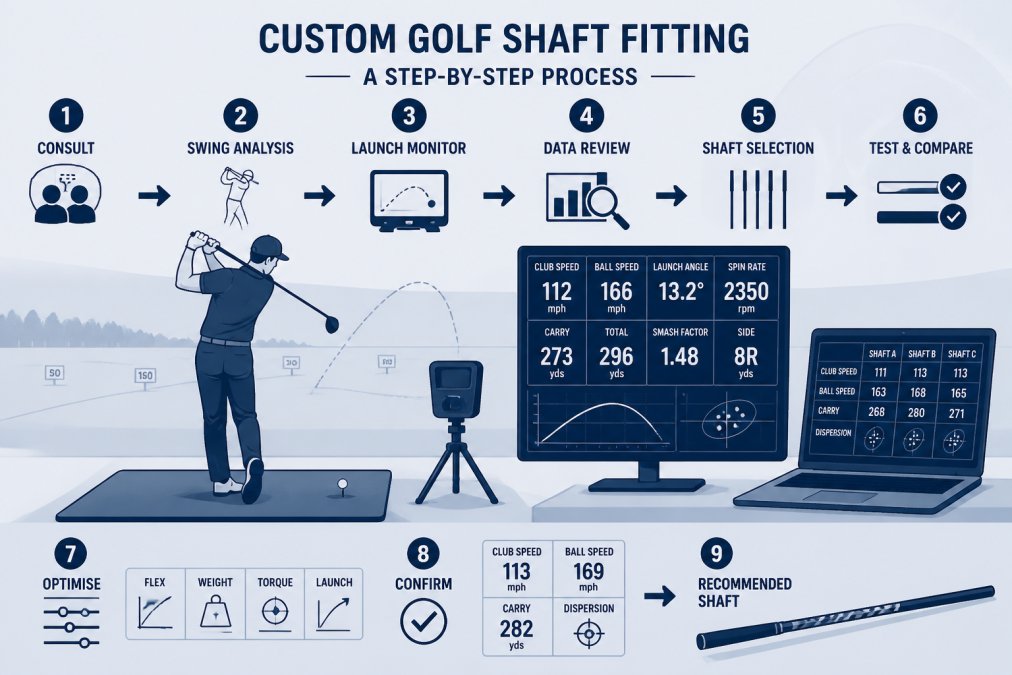
Step 1: Measure Your Swing Speed and Tempo
Start by measuring your swing speed with a launch monitor. This gives you a number, but it's only half the story. You also need to understand your swing tempo, how quickly you accelerate through the downswing.
A launch monitor captures clubhead speed at impact. But it also shows you other data: launch angle, spin rate, and ball speed. These numbers tell you whether your shaft is loading and releasing at the right time.
Prime Graphite Shaft | X Flex →
Record at least 10 swings with your current setup. Look for consistency. If your clubhead speeds vary by more than 3 mph between swings, your tempo is inconsistent. If they're tight, your tempo is stable and repeatable.
Step 2: Assess Your Launch Angle and Spin Rate
Launch angle and spin rate work together to determine ball flight and distance. Too much spin, and the ball balloons up and comes down short. Too little spin, and the ball flies low and doesn't carry as far.
The ideal launch angle for most drivers is between 15-18 degrees. The ideal spin rate is between 2,000-3,000 rpm. But these numbers vary based on your swing speed and the conditions you play in.
A shaft that's too stiff will produce a lower launch angle and lower spin rate. A shaft that's too flexible will produce a higher launch angle and higher spin rate. By testing different flex profiles, you can dial in the launch and spin that maximises your carry distance.
Step 3: Test Shaft Profiles and Confirm Feel
Once you've identified your swing speed and tempo, test different shaft profiles. Hit at least 5-10 balls with each profile and record the data.
Pay attention to three things:
- Consistency: Does the shaft produce tight groupings of launch angle, spin rate, and clubhead speed? Consistency matters more than raw numbers.
- Feel: Does the shaft feel responsive without feeling whippy? Does it feel stable through impact?
- Results: Are you hitting the centre of the clubface more often? Is your ball flight predictable?
The best shaft is the one that feels natural to your swing and produces the most consistent results. Don't chase raw numbers. Chase consistency and feel.
What Distance Gains to Realistically Expect
Distance gains from a custom shaft depend on how far off you were to begin with. If you've been using a shaft that's completely wrong for your swing, you might see 15-25 yards of improvement. If you're already fitted reasonably well, gains will be smaller, maybe 5-10 yards.
Most golfers see their biggest gains in consistency, not raw distance. A custom shaft reduces shot dispersion. Your good shots stay good, and your bad shots aren't quite as bad. Over a round, that consistency adds up to lower scores.
Here's what you should expect:
- Tighter shot dispersion: Shots cluster more closely around your target line.
- More predictable ball flight: You know what your ball will do before you hit it.
- Better feel at impact: You can sense whether you've hit the centre of the clubface.
- Modest distance gains: 5-15 yards is realistic for most golfers.
Don't expect a custom shaft alone to transform your game. A shaft is one variable. Your swing mechanics, your fitness, your mental game, these all matter. A custom shaft optimises what you already have. It doesn't create something from nothing.
Common Mistakes to Avoid When Upgrading Your Shaft
Most golfers make the same mistakes when choosing a shaft. Knowing these mistakes will help you avoid them.
Mistake 1: Choosing flex based on age or handicap. Your age doesn't determine your flex. Your swing speed does.
Mistake 2: Buying the same shaft as your playing partner. Your playing partner's shaft works for their swing. It might be completely wrong for yours. Get fitted to your own swing, not to someone else's.
Mistake 3: Assuming a more expensive shaft is better. Price and performance aren't the same thing. A shaft that costs more isn't necessarily better for your swing.
Mistake 4: Ignoring launch angle and spin rate. Raw clubhead speed is only part of the story.
Mistake 5: Upgrading the shaft without addressing other variables. If your grip is worn, your lie angle is off, or your swing mechanics are inconsistent, a new shaft won't fix those problems.
Custom golf shafts improve distance when they're matched to your swing. But the match has to be precise.
Frequently Asked Questions
Can a custom golf shaft actually increase my driving distance?
Yes, but only if the shaft matches your swing speed and swing characteristics. A shaft that is too stiff or too flexible for your tempo will reduce distance and consistency. Custom golf shaft fitting identifies your ideal flex profile, weight, and length to optimise energy transfer and launch angle. Most golfers who upgrade to a properly fitted shaft see improvements in ball flight stability and shot dispersion, though distance gains vary based on how far off your previous setup was.
How does shaft flex affect distance and ball flight?
Shaft flex determines how much the shaft bends during your swing. A shaft that is too stiff resists loading, creating a higher launch angle and reduced energy transfer. A shaft that is too flexible can produce excessive spin and inconsistent ball flight. The correct flex for your swing speed allows the shaft to load smoothly and release at impact, promoting an optimal launch angle, controlled spin rate, and consistent carry distance. Regular flex typically suits swing speeds under 85 mph; stiff flex works for 85-95 mph; extra-stiff for 95+ mph.
What role does driver shaft weight play in distance and accuracy?
Shaft weight influences clubhead speed and swing tempo. A lighter shaft (around 40-50 grams) allows faster clubhead speed and higher ball speed, potentially adding distance. A heavier shaft (55-70 grams) can improve stability and shot control, especially for golfers with aggressive tempos. The trade-off is that heavier shafts may reduce clubhead speed slightly. The best choice depends on your swing tempo and consistency. A custom fitting using launch monitor data reveals whether a weight change would improve your launch characteristics and distance without sacrificing accuracy.
Should I get a professional fitting before buying a custom shaft?
Professional fitting is highly recommended. A launch monitor reveals your actual swing speed, launch angle, spin rate, and ball speed under real swing conditions. This data eliminates guesswork and ensures your shaft choice matches your swing profile. Many fitters can also identify whether your current shaft is causing distance loss through excessive spin or poor launch. If you know your swing speed and have hit multiple shafts, you can make an informed choice independently, but a fitting session provides measurable data that prevents costly mistakes.