

Do Golf Shafts Lose Performance? A 2026 Guide
Last Updated: October 23, 2026
Quick Summary
Yes, golf shafts lose performance through material fatigue, sudden damage, or changes in your swing that make an old shaft unsuitable for your current game. A quality graphite shaft typically stays in serviceable condition for 5-10 years of regular play, while steel shafts can perform for 10-15 years or more.
- Graphite shafts lose stiffness over time through material fatigue from swing cycles and impact stress.
- Visible cracks near the hosel are a serious sign and mean the shaft should not be played.
- Performance loss and shaft age are not the same thing; a five-year-old stored shaft may play better than one hit weekly.
- Replace a shaft when you lose 5-10 yards of distance, experience inconsistent ball flight, or notice wobble during your swing.
- Storage conditions like temperature swings, humidity, and UV exposure accelerate material degradation in graphite shafts.
Table of Contents
- Do Golf Shafts Actually Lose Performance Over Time?
- How Long Do Golf Shafts Last With Regular Play?
- Common Golf Shaft Damage Signs and What They Mean
- Does a Golf Shaft Lose Stiffness Over Time?
- How to Inspect Your Golf Shaft: A Practical Checklist
- Steel vs. Graphite Shafts: Which Lasts Longer?
- When to Replace Your Golf Shaft: A Decision Framework
- Frequently Asked Questions
Do Golf Shafts Actually Lose Performance Over Time?
The short answer: yes, golf shafts lose performance, but not always in the way golfers assume. At Prime Golf Shafts, we've worked with serious players long enough to know that age alone doesn't determine whether a shaft still performs. What matters is how that shaft has been used, stored, and maintained.
Most golfers think shafts wear out like tyres, gradually losing their snap until one day they're simply done. The reality is messier. Golf shafts lose performance through sudden damage, through material fatigue from thousands of swings, or through changes in your own swing that make an old shaft unsuitable for your current game. Sometimes a shaft that's been in a bag for five years plays better than one that's been hit every week.
The key insight: performance loss and shaft age are not the same thing. Understanding the difference changes how you decide whether to replace a shaft or keep gaming with what you have.
How Long Do Golf Shafts Last With Regular Play?
A quality graphite shaft typically stays in serviceable condition for 5-10 years of regular play, depending on swing speed, impact location, and storage. This is not a hard deadline, it's a window. Some shafts last longer. Others fail sooner.
Steel shafts are more durable than graphite in terms of material fatigue, but they're heavier and less forgiving. A well-maintained steel shaft can perform for 10-15 years or more because the material simply doesn't degrade the way composite materials do.
What "regular play" means matters. A golfer who plays twice a week will stress a shaft differently than someone who plays twice a month. A golfer with a 95 mph swing speed creates different loads than a player swinging at 110 mph.
The real variable isn't time, it's impact cycles. Every swing loads the shaft. Every off-centre hit stresses it differently. Storage conditions (temperature swings, humidity, direct sunlight) accelerate material degradation.
Common Golf Shaft Damage Signs and What They Mean
Visible damage tells you something has gone wrong. But not all damage means the shaft is finished. Learning to read the signs helps you decide whether a shaft is still safe to play or needs replacing.
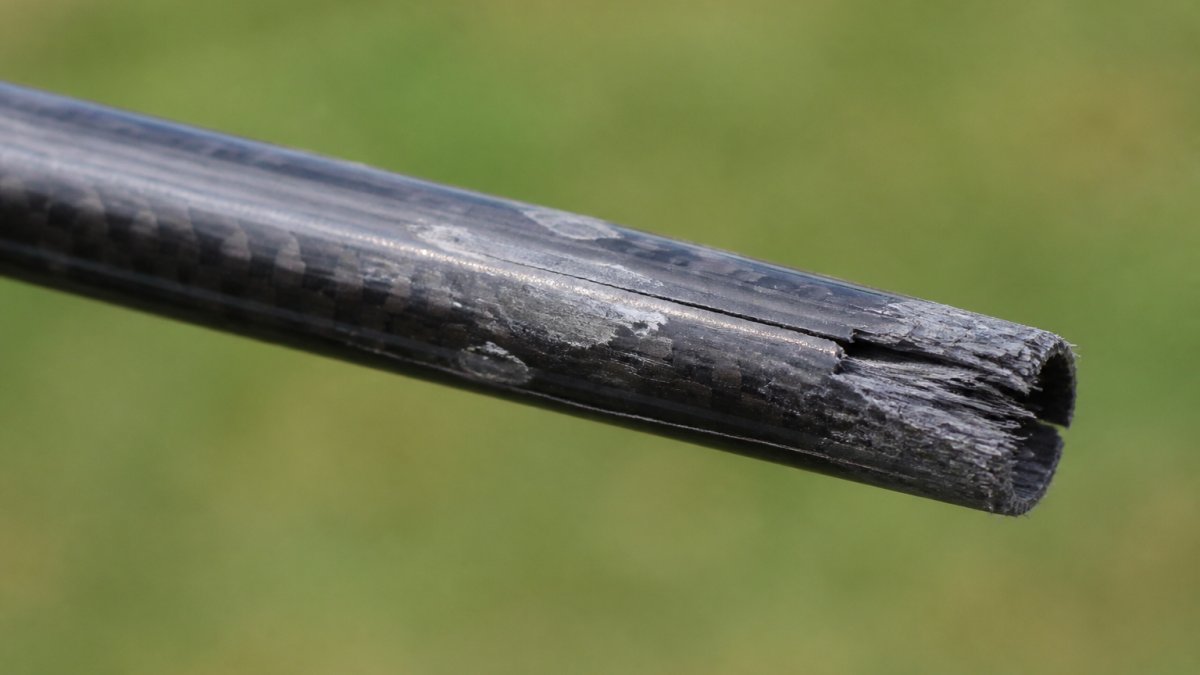
Visible damage: cracks, fraying, and rust
Cracks in graphite are the most serious sign. A small hairline crack near the hosel (where the shaft meets the clubhead) is often a death sentence for that shaft. Cracks propagate with every swing. They compromise the structural integrity of the composite material.
Fraying at the tip or butt end of a graphite shaft suggests the composite layers are separating. This usually happens after years of play or after a hard impact.
Rust on a steel shaft is cosmetic unless it's deep. Surface rust can be cleaned. But rust that has pitted the metal (creating small divots in the surface) weakens the shaft structurally.
Performance clues: wobble, inconsistent ball flight, and distance loss
Wobble is not a technical term, but golfers know what it means. When you swing, the shaft should load smoothly and release consistently. If the shaft feels unstable, like it's flexing in an odd direction or recovering unevenly, something has changed.
Inconsistent ball flight is often blamed on swing mechanics, but it can be a shaft problem. If your shots are suddenly more scattered than usual, and your swing hasn't changed, the shaft might be the culprit. A shaft that's lost stiffness or has internal damage will produce less consistent energy transfer to the clubhead.
Distance loss is the most obvious sign, but it's also the hardest to diagnose because many factors affect distance. A shaft that's lost stiffness will feel softer and produce less ball speed off the clubface.
Does a Golf Shaft Lose Stiffness Over Time?
Yes, graphite shafts do lose stiffness over time through material fatigue. This is not theory, it's a documented property of composite materials. Every swing flexes the shaft. The composite material has a fatigue limit. Enough cycles, and the material doesn't return to its original stiffness.
The rate of stiffness loss depends on several factors:
- Swing speed: Faster swings load the shaft harder and accelerate fatigue
- Impact location: Off-centre hits create asymmetrical stress that degrades the material faster
- Flex rating: A shaft that's too soft for your swing speed fatigues faster because you're loading it beyond its design parameters
- Material quality: Premium graphite compounds resist fatigue better than cheaper materials
- Storage: Temperature swings and UV exposure degrade composite materials
Steel shafts lose stiffness too, but more slowly. Steel is an isotropic material, it behaves the same in all directions. Graphite is anisotropic, it's engineered to flex differently along different axes. This makes graphite more responsive but also more prone to fatigue-related stiffness loss.
The practical implication: a shaft that felt like an S-flex five years ago might play like a regular flex today. If your swing speed hasn't changed but the shaft suddenly feels too soft, stiffness loss is the likely reason. This is often when golfers decide to replace a shaft, not because it's broken, but because it no longer matches their swing characteristics.
How to Inspect Your Golf Shaft: A Practical Checklist
A proper inspection takes 10 minutes and tells you whether a shaft is worth keeping or ready for replacement.
Visual inspection steps
Start with the basics:
- Check the hosel connection. Does the shaft sit flush in the hosel? Is there a gap? Can you move the shaft by hand? A loose connection means the adapter or hosel itself is damaged.
- Run your hand along the shaft. Feel for cracks, rough spots, or areas where the finish is peeling. Graphite shafts should feel smooth. Any irregularity is a warning sign.
- Look for discolouration. Fading or yellowing suggests UV damage. Darkening near the grip end can indicate moisture damage or heat exposure.
- Inspect the grip end. Is the butt end frayed? Are there cracks in the composite? This is common after years of play but indicates material degradation.
- Check for bends or kinks. Sight down the shaft against a light background. A bent shaft will not perform consistently and should be replaced.
Performance testing methods
Visual inspection tells you about damage. Performance testing tells you whether the shaft still does its job.
The swing-speed test: Use a launch monitor or swing analyser (many golf ranges now have them) to measure ball speed and launch angle with the suspect shaft. Compare these numbers to a baseline shaft you know is in good condition.
The dispersion test: Hit 10 shots with the suspect shaft and measure the spread of your shots. Use a rangefinder to get carry distances. Calculate the standard deviation. Then hit 10 shots with a shaft you're confident in and compare. A shaft that's lost performance will produce wider dispersion.
The feel test: This is subjective but valid. Hit shots with both shafts and pay attention to how the shaft loads and releases. Does the suspect shaft feel softer? Does it release unevenly? Does the feedback feel muted? These sensations often correlate with stiffness loss or internal damage.
Steel vs. Graphite Shafts: Which Lasts Longer?
Steel shafts last longer in terms of material durability. Steel doesn't fatigue the way graphite does. A steel shaft that's been hit 10,000 times will still be stiff. A graphite shaft hit 10,000 times will have lost some stiffness.
But longevity isn't the only consideration:
| Factor | Steel | Graphite |
|---|---|---|
| Material durability | 10-15+ years | 5-10 years |
| Stiffness retention | Excellent | Degrades over time |
| Feel and feedback | Firm, less forgiving | Softer, more responsive |
| Performance consistency | Stable, predictable | Declines with age |
| Weight | Heavier (requires stronger swing) | Lighter (suits broader range) |
| Cost | Generally lower | Generally higher |
The choice between steel and graphite isn't about which lasts longer, it's about which matches your swing and priorities. Steel is the better choice if you want maximum durability and you have the swing speed to generate distance with a heavier shaft. Graphite is the better choice if you want feel, responsiveness, and a shaft that performs optimally throughout its lifespan rather than gradually degrading.
For serious amateurs, the real answer is this: buy the shaft that performs best for your swing now, and plan to replace it when performance loss becomes noticeable. A graphite shaft that plays perfectly for five years is a better investment than a steel shaft that plays adequately for ten.
When to Replace Your Golf Shaft: A Decision Framework
Replace a shaft when one of these conditions is true:
Condition 1: Visible damage that compromises safety. A crack, severe fraying, or a bend means the shaft should come out of the bag immediately. These are non-negotiable.
Condition 2: Performance loss that affects your game. If you've lost distance, consistency, or feel, and you've ruled out swing changes or other club issues, a shaft replacement is worth trying.
Condition 3: Shaft flex no longer matches your swing. Your swing speed may have changed. Your fitness level may have improved. Your technique may have evolved.
Condition 4: Shaft age + usage pattern suggests fatigue. If you've been playing the same shaft hard for 7+ years, stiffness loss is likely.
When not to replace: If a shaft performs well, feels good, and shows no visible damage, keep playing it.
The decision framework in practice: measure carry distance with the suspect shaft. Compare to a known baseline. If the difference is more than 5-10 yards, replacement is justified.
At Prime Golf Shafts, we build custom shafts designed to maintain performance through years of play.
Frequently Asked Questions
Do golf shafts lose performance over time with normal use?
Yes, golf shafts can lose performance through gradual wear, fatigue, or unsuitable flex for your swing. Graphite shafts are prone to micro-fracturing inside the composite material, which reduces energy transfer efficiency. Steel shafts develop metal fatigue. Performance loss is usually gradual rather than sudden, but off-center impacts and poor storage accelerate degradation. Regular inspection helps you catch problems before they significantly affect your game.
How can you tell if a golf shaft is damaged without visible cracks?
Watch for performance changes: inconsistent ball flight, reduced carry distance, increased shot dispersion, or a hollow sound on impact. A shaft that feels too flexible or too stiff compared to your usual swing suggests internal damage. Wobble when you waggle the club is another sign. Some damage occurs inside the composite without external cracks. If your swing hasn't changed but your results have deteriorated, the shaft is likely the culprit.
Does a golf shaft lose stiffness with age, and how does that affect my game?
Graphite shafts can lose stiffness through micro-fracturing and material fatigue over thousands of swings. A shaft that becomes too flexible for your swing speed launches the ball higher with more spin, reducing distance and control. Launch angle and spin rate increase unpredictably, leading to inconsistent shot patterns. Steel shafts are more resistant to stiffness loss but still fatigue over time. If your shaft has lost stiffness, you'll notice the ball climbing higher than before and landing softer, costing you yardage and consistency.
Should I replace my golf shaft if I've changed my swing speed or strength?
Yes. A shaft matched to your old swing speed will perform poorly if your swing has strengthened. Too flexible a shaft causes high launch and excessive spin; too stiff reduces launch and ball speed. Ensuring your shaft specification, flex, weight, and taper, aligns with your current characteristics is especially important for serious amateur golfers who've invested in coaching or training. The right shaft for your current swing delivers better feel, consistency, and distance.
